What happened.
We wanted to show a humanoid robot.
In November 2025, that was the plan. Not as a marketing reflex. We believed a humanoid could make visible what we mean by Industrial Intelligence.
In December 2025, a small group from CEO, CTO, COO and Corporate Development flew to Tokyo for iRex. The world’s largest robotics fair. We came back with the opposite of what we’d expected.
Humanoids on a stage are impressive. On a print floor, they aren’t yet at the level you’d expect from Durst. They will be. Whether they’re the right answer for print shops in the first place is a separate question. Not by Fespa 2026 or for our Durst NEXT Festival.
We want to show reality. Not noise. In January, we sat down in Brixen with a question. What’s honest enough to build, to show, to make real? What is real innovation. And what is just noise today?
What came out of that, we call the Sandbox. This paper is half vision, half status report from inside it. The two halves can’t be separated.
“We had a choice: a humanoid on stage, or an open innovation approach with the Kyveris Sandbox. The second is harder. It’s also more honest.”
Print is alive.
Print is alive. Print is visible – our world is printed.
What no one would have printed ten years ago is now everyday work. Personalized packaging. Short runs with a hundred variants.
Our customers’ market is growing. Especially where what’s printed has to be touched, felt and held, and where a screen is no substitute. New business models emerge. Runs get shorter, variants multiply, substrates grow more diverse, and deadlines keep tightening.
Where it used to be ten jobs a day, it’s now up to ten jobs an hour or even more.
This isn’t a crisis. It’s the opportunity. It belongs to the print shops that can serve faster and more flexibly than ever before.
Not a faster machine. A different question. The years in digital print won’t be decided by individual improvements. They’ll be decided by production systems that are connected to each other.
Data isn’t enough.
The problem isn’t having data. It’s understanding it. A printing press generates enormous amounts of data. So does a finishing line. So does substrate handling. The question is never whether data exists. The question is whether anyone, or anything, understands what it means in context.
Today, that understanding lives in people’s heads. Why the press paused for nine seconds. Which vacuum zone has to be adjusted for this substrate…
Most of the critical operational knowledge in manufacturing is undocumented. It lives in heads, not in systems.
Why now.
Other industries solved automation years ago. Think of the assembly lines and robot cells in automotive production. Digital print didn’t, and not out of laziness, but because our processes are different.
The state of a printing press depends on many things at once: the substrate, the ink set, the machine geometry, the room around it, and the operator’s last twenty decisions. And it never stands still. It keeps changing, all day long.
Then AI arrived, along with cheaper sensors, mature data architectures and a wave of new tools. That’s the real trigger. What’s changing isn’t the industry. What’s changing is how we can think.
Suddenly it’s within reach. The tools, the AI, the sensors, the data architectures are finally mature enough to take this on in digital print. We’re not behind. We’re starting now.
A question of mindset. Not technology. The technology isn’t fully there yet, but it’s evolving fast, and something new is being built from it. What it really takes is the willingness to think differently: not from the machine outward, but from the system inward.
The Sandbox.
We built the Sandbox around concrete examples, not around a generic process map. Material flow. Substrate handling. Print execution. Quality, and how it’s judged. Job intelligence. And more.
In January, we tried to explain Kyveris and the Sandbox on a single slide, example by example. It didn’t work. Not because the audience couldn’t follow, but because everything depends on context, and context is exactly what a single slide can’t carry.
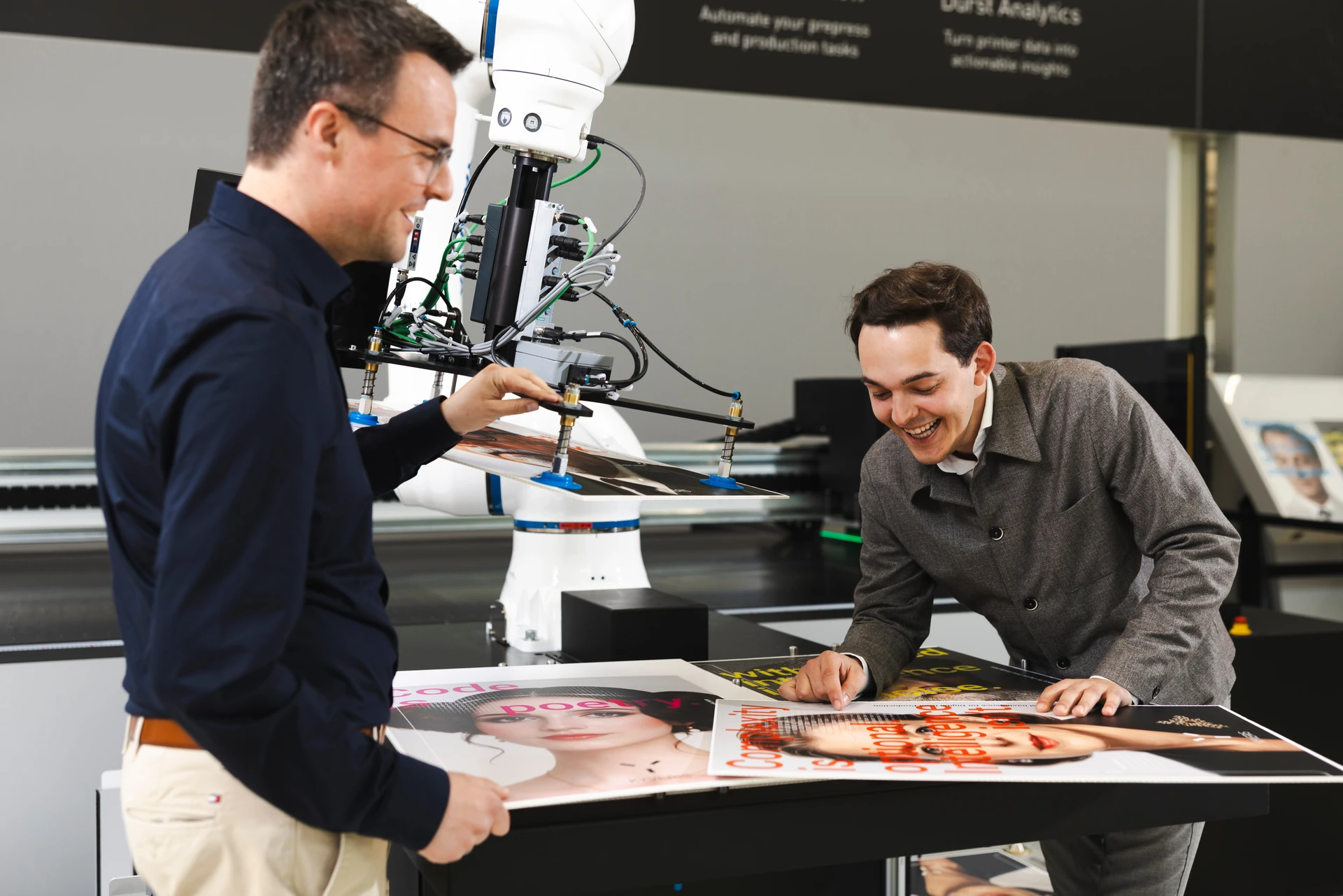
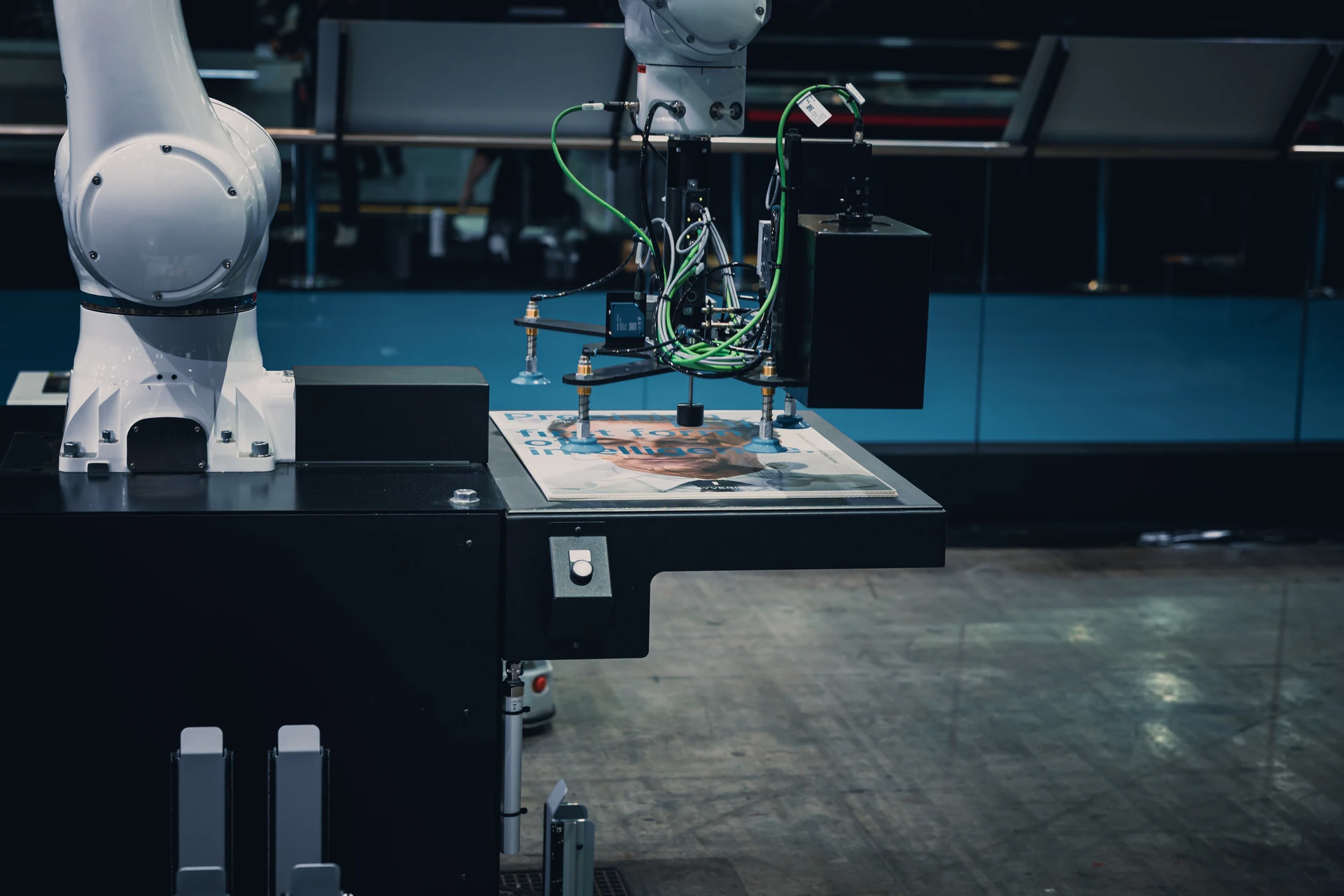
A robot that places a substrate with 0.2 mm precision is impressive on its own. But if the press underneath isn’t set up for that substrate, with the vacuum that holds it down tuned for a different material, the precision is wasted. The substrate shifts, and the result is off.
It’s all about context.
That was the moment the Sandbox stopped being a collection of prototypes and became a single argument. Industrial Intelligence isn’t a set of features added to a machine. It’s the connection between disciplines that, until now, have worked as if the others weren’t in the room.
Out of those weeks came a small, young team in Brixen. Drive. Attitude. Clear roles. Moving fast, with a clear narrative.
“We were a small, young team. Drive, attitude, clear roles. That was all we needed — and all we had.”
Not architecture. Practice. We started with a machine, with real production data from live installations, and with a list of things we thought we could automate.
What we could honestly build, we built. What we couldn’t build yet, we left visible, not behind stock footage, not behind marketing films from the computer.
An example. At first we thought we’d need pins to register the substrate on the table. But the substrate wasn’t flat enough for pins to work, so we tried it without. It worked. Out of necessity, a virtue.
Not designed. Tried. Sometimes the simpler solution is closer at hand than the planned one.
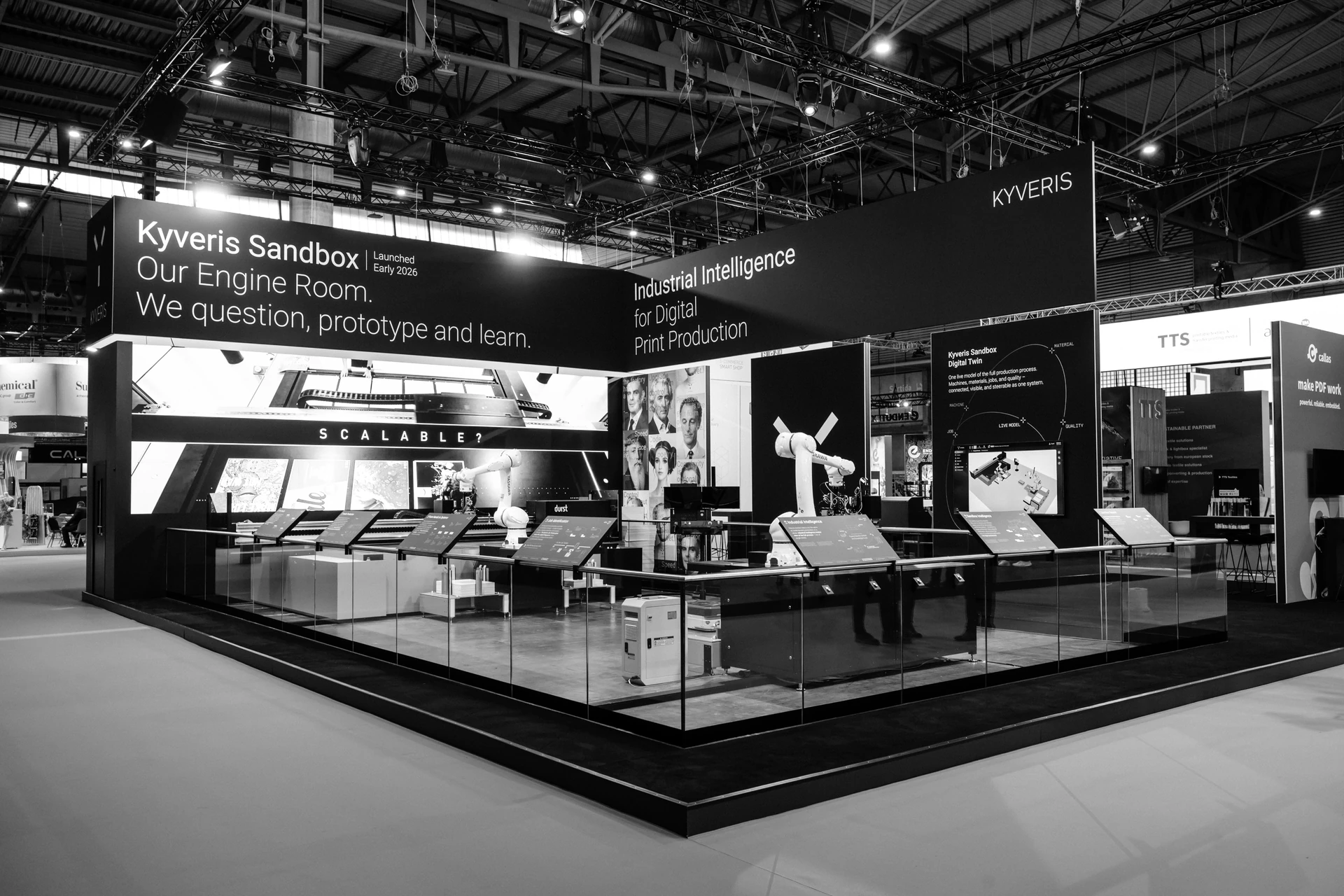
What runs on the booth screen in Barcelona, and at D90 in Brixen, isn’t a simulation. Press, vacuum table, cobot and AMR are all connected. It’s not the perfect UX, but it runs, and we learn every time from scratch.
“When everything ran through for the first time in Lienz (End of April), it felt almost meditative. Four systems, one rhythm. No human call. No cue from outside.”
What we don’t know yet.
We don’t know yet how an operator will work with a system like this in the future. We have hypotheses. We test them in the Sandbox. We expect some of them to turn out wrong — and we’ll learn from the ones that do.
We don’t even know yet what counts as a discipline here. That defines itself in practice, not from an architecture we drew in advance.
What we do know: more is coming. In the order reality shows it to us. And we don’t do this alone. We challenge the Sandbox together with customers, partners and everyone who joins in. This is the core of it: we are building Industrial Intelligence for digital print production. Building. For now, it’s an approach, and products will follow in the order the approach sets, not in a roadmap.
Process knowledge that today walks out of the hall with every shift change, we make shareable. And we free up time for what people do better than any machine: be creative, take responsibility, judge what’s right.
This is the start.
The Sandbox isn’t the answer. It’s the first version of our approach in which an answer can take shape.
It’s open. It’s unfinished. That’s exactly its strength.
What we build, we don’t build for ourselves. We build it for the people who stand on a print floor and want to do it differently than it’s been done.
“The next decade won’t be decided in roadmaps alone. It will be decided in approaches that run differently — different from yesterday, different from today.”
If the question we’ve been sitting with since January is also one you’ve been sitting with, find us in Barcelona and at D90 at our Headquarters in Brixen. Walk in. Watch. Ask.
Make it your workplace, not ours.
— The Kyveris Sandbox Team, June 2026